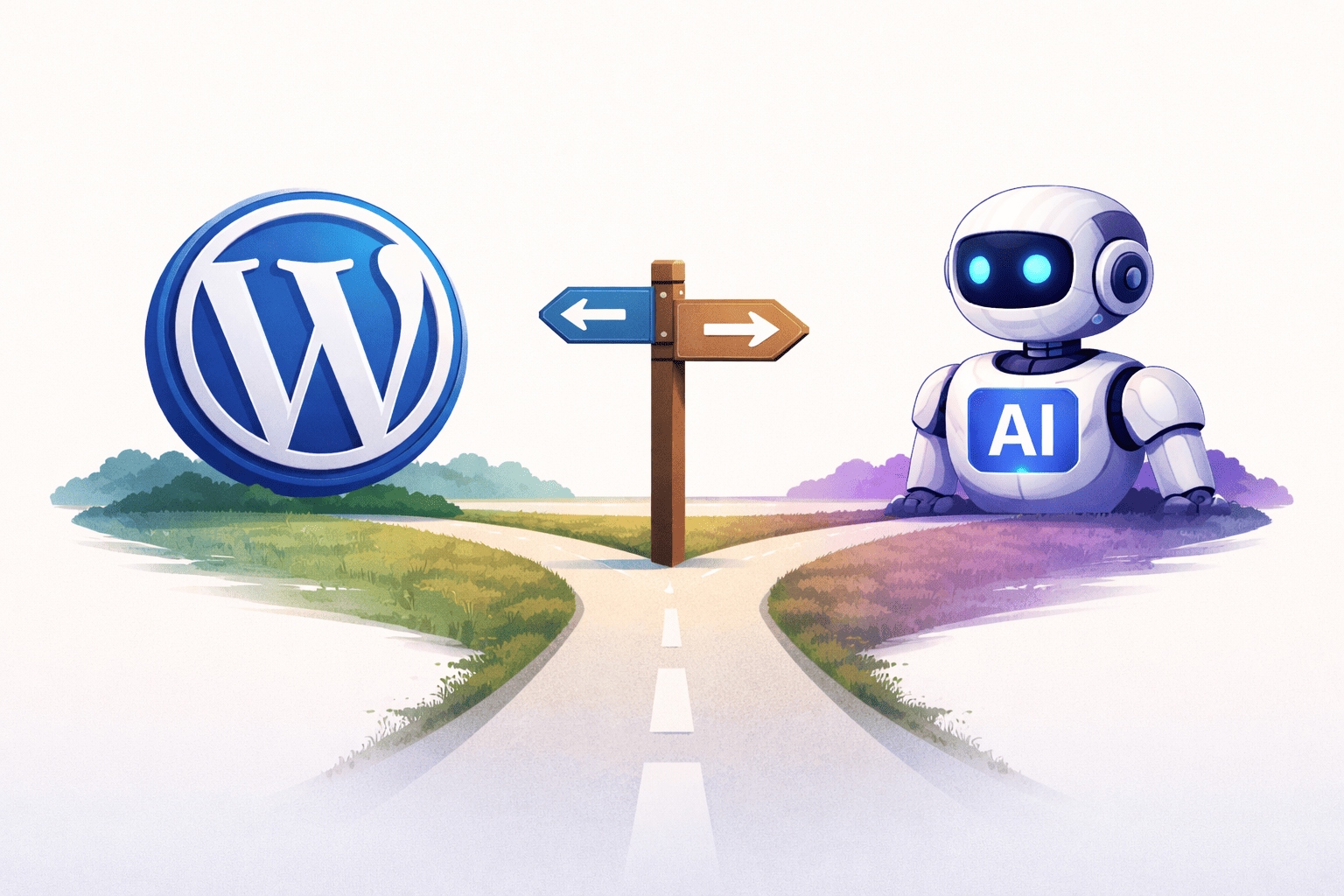
With so many new things emerging at the same time, I’ve found myself asking a question more often than I’d like to admit: does WordPress still make sense for everyone today?
Especially after this whole AI boom.
It’s never been easier to create something. You open a tool, describe what you want, and within minutes you have a page ready, with layout, copy, and even some interactions. That completely changes the starting point for anyone trying to get something online.
And that’s where a point comes in that, in my opinion, a lot of people still avoid facing directly.
Not everything needs WordPress
WordPress is not for everyone. And honestly, it never was.

For a long time, it may have been the best possible answer to a wide range of problems. And in many cases, it still is. But the landscape has changed. Today, there are simpler, faster, and in some contexts, more efficient alternatives.
If the goal is to validate an idea, create a landing page, or just have a basic online presence, it often doesn’t make sense to carry the full weight of a CMS.
I’ve caught myself thinking about this in some recent projects. That feeling of using a tool that’s too powerful for something that could be solved in a much more direct way.
And that’s not a problem with WordPress itself, but with the choice we make when we don’t stop to evaluate the context.
When complexity starts to matter
At the same time, once you start dealing with slightly more complex projects, the conversation changes completely.
When there’s a significant amount of content, multiple people involved, a need for organization, review, and consistency… there’s not much of a way around it.
You need structure.
And that’s exactly what a CMS provides.
At its core, WordPress was never really about “building websites” in the simplest sense. It has always been about managing content. Giving autonomy to non-technical users. Creating a foundation where content can grow without turning into chaos.
Where AI still falls short
And this is exactly where I see a clear limitation in AI-based approaches today.
As impressive as they are for generating things quickly, editing is still not as natural as it seems. You depend on prompts, iterations, and adjustments that aren’t always straightforward.
Sometimes, a simple change turns into a sequence of attempts until you get what you want.
Of course, this is evolving fast. Probably faster than we can fully keep up with. But at least for now, it still doesn’t fully replace the experience of opening a page and editing it directly in a visual way.
The most likely path
What I believe will happen is not a replacement, but a convergence.
Interfaces are becoming more conversational, costs tend to decrease, and over time these two approaches will meet somewhere in the middle.
WordPress itself is already moving in that direction, exploring ways to integrate AI into the creation and editing workflow.
Why WordPress still remains relevant
Even with all of this happening, there’s something that still strongly works in WordPress’s favor: time.
It’s been evolving for more than two decades, with a massive community, a mature ecosystem, and a level of flexibility that few tools can match.
That brings a level of trust that’s hard to replicate in newer solutions.
And at the end of the day, it still solves a problem that hasn’t gone away: organizing and managing content at scale.
Conclusion
In the end, the answer isn’t as binary as it might seem.
WordPress is not for everyone. AI doesn’t solve everything on its own either. Each approach has its place, its strengths, and its limitations.
The main point, at least for me, is to stop choosing tools based on trends and start choosing based on actual needs.
Understanding the stage of the project, the level of complexity, who’s going to use it daily, and how it might evolve over time.
Because in the end, it’s not about using WordPress or AI.
It’s about building something that actually makes sense.
Leave a Reply